
Ageliana, Mylopotamos, 74052, Rethymno, Greece
info@cretanthos.com / cretanthosofficial@gmail.com
+306982070427 / +302834022192


Ageliana, Mylopotamos, 74052, Rethymno, Greece
info@cretanthos.com / cretanthosofficial@gmail.com
+306982070427 / +302834022192
Copyright of images and objects from museums or archaeological sites belongs to the Hellenic Ministry of Culture and Sports, Law 3008/2002. All the exhibits on display within the Cretanthos theme olive park are exact replicas of the original items depicted in the images on the online platform here. The purpose of the Cretanthos theme park and online platform is to provide the visitor with historical information about the olive culture through the centuries and how it was connected to the way of life of the people in Crete and the Greek area.
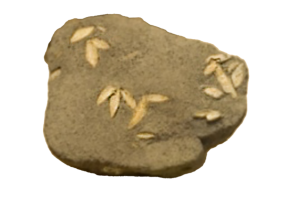
Α-1. Fossilized Olive Leaves
Representation of fossilized 60 000-year-old olive leaves of that were found in different areas of Greece like Santorini, Nisyros and around the ancient Knossos in Crete. The original fossilized olive leaves came to light with the excavations of the German archeologist Friedrich Hiller von Gaertringen in Santorini in 1895-1900 and they are exhibited at the Museum of Prehistoric Thera in Santorini. These fossils testify that the olive tree was an integral part of the Greek flora from ancient times, 60 000 years ago. Also, these fossils are the oldest findings that prove the presence of olive trees on the Greek islands and consequently the possible use of olive oil and olive fruits as a supplementary source of food during the Late Cycladic I period, i.e. the 17th century BC.
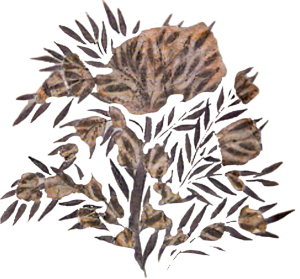
Α-2. Fresco from the Knossos Palace – The first cultivations
Representation of an olive tree from a fresco of the Palace of Knossos during the period of the Minoan civilization in Crete, namely in 3000 BC – 1450 BC. The fresco was discovered during the first excavations by Minos Kalokerinos in the area of Knossos in 1878, but in fact it became more prominent during the following excavations by sir Arthur Evans in 1900-1913 and 1922-1930. Also, in the same excavations, large clay jars and other types of storage which contained olive oil residues were found in the middle of the period. This led the archaeologists to conclude that olive trees and their derivatives contributed significantly to the flourishing of trade and the development of the Minoan civilization. So the existence of frescos with the olive tree in the Minoan palaces of Knossos is therefore justified.
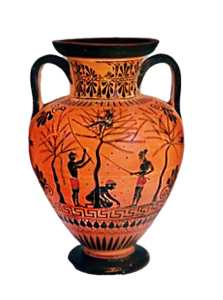
Α-3. A “special” cultivation
Copy of a 40,6cm-high black-figure Attic amphora from 530-510 BC in which the process of harvesting olive fruit by eunuchs is depicted. Today, the authentic Attic amphora is on a permanent display in the British Museum. It depicts three “Mories”, namely olives trees. On the middle olive tree is seated a young eunuch who shakes down olives so that they fall to the ground. On the right and left there are another two young men who beat the olive tree with their sticks. These trees are called Mories , as according to the myth of the time, all olive trees originated from molecules/pieces of the first olive tree that dominated the sacred rock of Acropolis in Athens. Herodotus, the father of history, wrote in 500 BC. that the cultivation and export of olives and olive oil was so sacred that only virgins and eunuchs had the possibility to cultivate estates with olives. After the Peloponnesian War, (431-404 BC) the Athenians faced a serious problem with olive moles. Many of the olive trees had been burned during the war, but no one was allowed to clear the burnt logs through the olive groves of Attica, nor to disturb the sacred enclosures that had been placed around them.
Α-3. A “special” cultivation
Copy of a 40,6cm-high black-figure Attic amphora from 530-510 BC in which the process of harvesting olive fruit by eunuchs is depicted. Today, the authentic Attic amphora is on a permanent display in the British Museum. It depicts three “Mories”, namely olives trees. On the middle olive tree is seated a young eunuch who shakes down olives so that they fall to the ground. On the right and left there are another two young men who beat the olive tree with their sticks. These trees are called Mories , as according to the myth of the time, all olive trees originated from molecules/pieces of the first olive tree that dominated the sacred rock of Acropolis in Athens. Herodotus, the father of history, wrote in 500 BC. that the cultivation and export of olives and olive oil was so sacred that only virgins and eunuchs had the possibility to cultivate estates with olives. After the Peloponnesian War, (431-404 BC) the Athenians faced a serious problem with olive moles. Many of the olive trees had been burned during the war, but no one was allowed to clear the burnt logs through the olive groves of Attica, nor to disturb the sacred enclosures that had been placed around them.
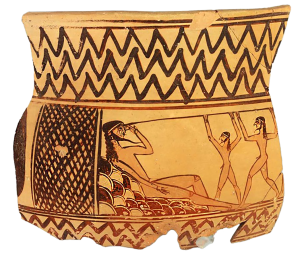
Α-5. The olive tree in Homer’s epics
Copy of a fragment of an Attic krater dated to the 7th century BC. and today it is in the Archaeological Museum of Argos, in Greece. On the fragment there is a representation of the scene with the blinding of the cyclops Polyphemus by Odysseus and his companions. The famous cyclops, son of the ancient God Poseidon, known from Homer’s Odyssey (rhapsody 240-630), lived in a cave on the mythical island of Thrinakia (today’s island Heraklia of the Small Cyclades, Greece). He captured Odysseus and his companions in his cave and then began to eat them, until Odysseus blinded him with a burning pole. Legend has it that this pole was made of wood from a sacred olive tree. Another myth states that during the quests between the ancient Greek city-states, the most elite warriors carried weapons of the time made of wood from sacred olive tree. Thus, they marched towards the battlefield with the mentality of a winner, a fact that contributed substantially to their performance.
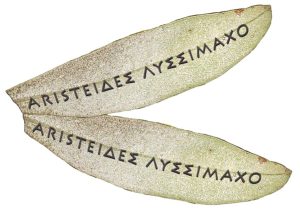
ARISTIDES LYSSIMACHOS
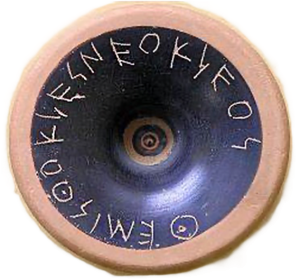
Α-6. Petalism and Ostracism
Representation of the two different ways of voting for the exile (banishment) of a citizen during the 5th-4th century BC. in the Greek areas. In Syracuse, in cases of voting to banish a citizen, the name of the one they wished to banish was written in ink on olive leaves. This process was called petalism. This event took place only once a year. The vote was secret, and the officials involved in its transparency process collected the olive leaves and ensured that no one fraudulently voted twice. Citizens who collected the most leaves with their name on were exiled from their city for 5 years. In ancient Athens, another process was applied, the ostracism. The names were engraved on fragments of vessels (ostraka) and the citizens who collected the most ostraka with their name on were forced to leave the city within 10 days for 10 years since they were considered too powerful or dangerous for their city. Ostracism was the supreme example of the power of the common people to deal with the abuse of power during the period of the Athenian democracy and lasted until the 4th century BC.
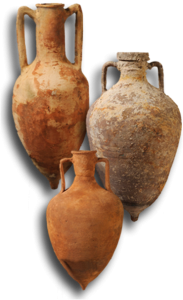
Α-7. The economic importance of olives and olive oil
Copy of 58-60cm high pointed amphorae from the 2nd century BC. These amphorae were suitable for transporting olive oil, as evidenced by many findings from ancient Greek shipwrecks. Important findings came to light through the underwater archaeological research of the Ephorate of Underwater Antiquities that took place in 2019 on the Levitha island between the Cyclades and the Dodecanese in the Aegean Sea. A total of 5 ancient Greek shipwrecks were identified with a number of amphorae from the Greek islands of Knidos, Kos and Rhodes dating back to the 2nd – 1st century BC. These particular amphorae were so named from the pointed extension they have instead of a flat base. The pointed base probably served to save space in the storage of vessels. The large number of amphorae found in multiple Greek shipwrecks testify the importance of economic transactions of olive oil of that time.
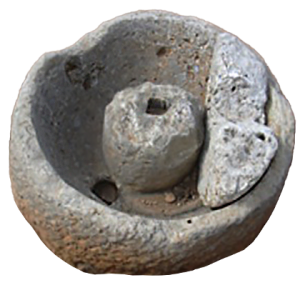
Olive stone mill in the Aptera village, Chania – Crete
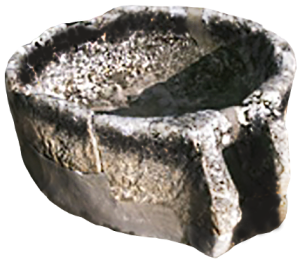
Stone olive oil separator, Knossos
Α-8. The first olive oil press
The Roman writer Gaius Plinius Secundus, who lived from 23 to 79 AD, was a naturopathic doctor and natural philosopher, and stated that the first olive press was invented by Aristaeus, son of God Apollo. According to the myth, Aristaeus learned from the Nymphs the art of making cheese from milk, honey from bees and olive oil from olives. In particular, they taught him to graft wild olive trees to tame them and make them more productive in olive fruit. He even learned to grind their fruit to produce olive oil through the invention of the olive press, the first olive stone mill in history. Finally, according to Diodorus Siculus, an ancient Greek historian and writer who lived between 80 and 20 BC, Aristaeus taught the people of Sardinia and Sicily how to cultivate the olive tree. His impact on olive production and crop sustainability was so strong that he was worshiped as an agricultural deity and protector of olive producers.
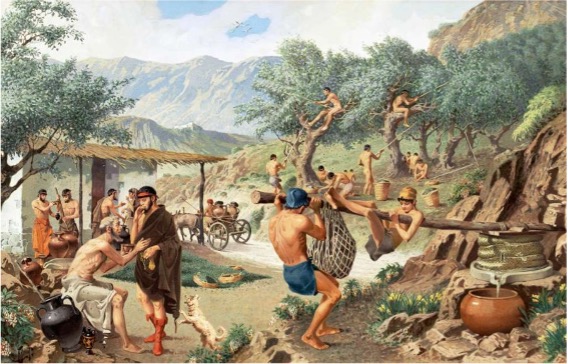
Historic representation of olive harvesting, Herbert Herget (1944)
Α -9. Harvesting systems
Regarding the methods of harvesting, the ancient Greek philosopher and scientist Aristotle mentions two different procedures for collecting the olives. According to the first one, which was valid until 390 BC, the city assigned the right to cultivate and collect the olives from the “Mories” olive trees to private producers, who gave the public the quantity, which had been previously agreed upon. But, after the 4th century BC the city now entrusted the collection of olives to a very important public lord. This lord was called “eponymous”, because he got his name from the year in which he was in power. The equally important change was that olive oil was not only produced from olives from the “guarded sacred trees”. The land owners, in which there were olive trees, were obliged to give the lord a certain quantity of olive oil. This quantity was used for the prizes given in the Panathenaic Games in ancient Athens. If the “eponymous” lord after the end of his term did not deliver to the treasurers of the city the prescribed amount of olive oil, he was not allowed to become an Areopagite since he had not performed his duty properly and was considered dishonest. Areopagite was the title of a citizen who was randomly chosen each time to judge his fellow citizens impartially in the court of Areopagus on the sacred rock of ancient Athens.
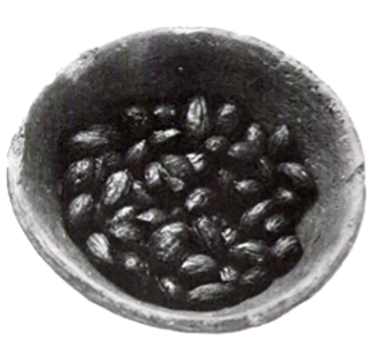
3500 year-old olives, Heraklion Archeological Museum
Α-10. The grades of olive oil
Photograph of intact 3500-year-old olives found inside a clay vessel filled with river water during the excavations of the Minoan Palace of Zakros in Crete. They were found in the warehouses of this palace, in 1963 by the excavator Nikolaos Platon. The story about these black Cretan olives that were kept juicy and alive for 3500 years in the water of the well is only confirmed by the description of Nicolaos Platon himself: “When they were taken out of the water they were as if they had been recently picked from the trees. This is clearly visible in the photographs taken at the time. Unfortunately, a few minutes later the olives shriveled rapidly…”. Today, the cup containing these olives in their current state, which differs from the form in which they were discovered, is exhibited in the Heraklion Archaeological Museum.
Olive oil has always been a basic element of the Greek diet since ancient times. There were three grades of olive oil. “Omotrives or omphakinon’’ namely the top quality olive oil that was produced from unripe olives, the equivalent of today’s “agourelaio” (early harvest olive oil). “Defteron Yevmatos” namely the good quality olive oil, the equivalent of today’s extra virgin olive oil and “Hydaion Elaion” namely the lower quality olive oil from overripe black or beaten olives, the equivalent of today’s lampante (bulk oil). More specifically, with the 1st pressing of the fruit, they got the olive oil for their food (omotrives or omphakinon and defteron yevmatos). With the oil from the 2nd pressing they made ointments for the body and the face. The oil from the 3rd pressing was used to power their oil lamps (bulk oil).
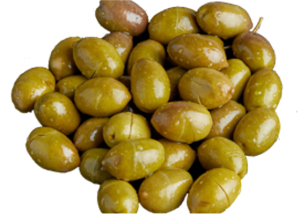
“Thlastai”
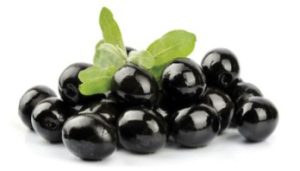
“Gogkilai”
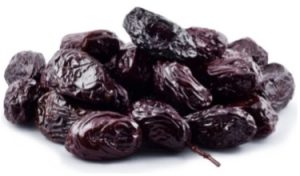
“Drypepes”

“Pityridai”
Α.11. Varieties of olives
Ancient writers save information about different already edible olives.
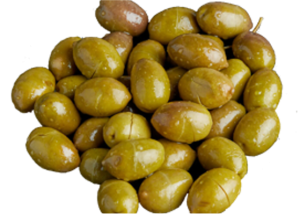
“Thlastai”olives – today’s olives tsakistes, that actually means “cracked”, in reference to their skin.
Derives from noun thlastos (θλαστός) which means bruised/cracked
“Kolymvades” – They are often cured in brine.
Derives from noun kolimpi (κολύμπι) which means swimming
“Almades” – kolymvades during the first stage of their processing with salt.
Derives from noun alme (άλμη) which means brine
“Gogkilai”– round olives, probably today’s olive “throumbes”.
Derives from noun gogkilos (γογγύλος) which means round
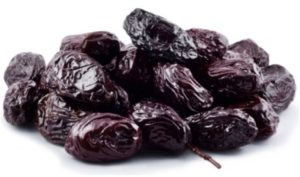
“Drypepes” – overripe wrinkled olives, which were consumed without processing.
Derives from noun druppa (δρύππα) which means overripe wrinkled olive
“Melanai” – it is mentioned by Athenaeus that they were black and indigestible. Athenaeus of Naucratis lived in the 2nd – 3rd century AD and was an ancient Greek biologist, botanist, gastronomist, dietitian, and grammarian originally from Naucratis, Egypt.
Derives from noun melanos (μελανός) which means dark color, black
“Pityridai” They were small and had the color of bran as they were harvested before they go green.
Derives from noun pitouro (πίτουρο) which means bran
“Stemfylides” – They were black olives from which stemfylon was made, pulp of grated olives, which together with herbs, oil and vinegar made epityron, namely today’s olive pulp.
Derives from noun stemfylon (στέμφυλον) which signifies the remains from pressing the olives after removing the oil
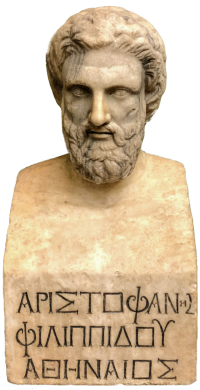
Α.12. “The olives of Aristophanes”
The great ancient Greek satirical poet of the 5th century BC. Aristophanes, likens mature women to wrinkled ripe olives while the young girls as unripe – firm and green olives dripping with salt! A classic example of Aristophanes parallelism.
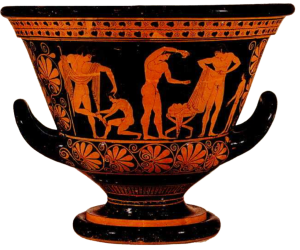
Red-figure krater with a representation of athletes’ preparation.
Α.13. Olive oil used as medicine
Copy of a red-figure krater with a representation of athletes preparing in a palaestra (public wrestling area) dating from 510-500 BC. and it is exhibited in the Altes Museum of Berlin. An athlete is depicted pouring olive oil from an aryballos (a small spherical container with a narrow mouth) to anoint his body. Besides its nutrition properties, olive oil was also used in ancient times for its therapeutic properties. The ancient Greek physician Hippocrates, who lived in 460 BC. – 377 BC and is considered one of the most prominent personalities in the history of medicine, characterizes the olive oil as a “great Healer”. The Hippocratic Corpus mentions more than 60 medicinal uses of olive oil, with the main use against skin diseases. In his book “On Regimen in Acute Diseases”, Hippocrates writes about olive oil: “In winter, oil is more conducive to growth, because it prevents the heat from leaving the body. In summer, due to heat the oil melts the flesh as it warms up due to season… Rubbing with oil and water softens the body and does not allow it to overheat”. Additionally, olive oil, as a food, helped to treat heart diseases. Besides olive oil, olive leaves and flowers were used for healing purposes, from which they prepared medicinal decoction and tea. Democritus, an ancient Greek pre-Socratic philosopher, who lived in 460 BC. – 370 BC, placed great importance on anointing the body with olive oil to maintain health. When he was asked how one can be healthy, he answered: “By soaking the inside with honey and the outside with oil.”
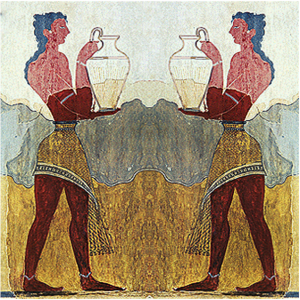
Representation at the Palace of Knossos
Α-14. Basic cosmetic
Copy of a fresco in the Palace of Knossos in Crete with a Minoan and an amphora aromatized with olive oil, as a gift to the Mythical King Minos. The “rhyton carrier” (carrier of a large conical rhyton vessel) is represented as sunburnt, with curly hair, strong shoulders and a thin waist, features of an ancient Minoan. The fresco was discovered during the extensive excavations by Sir Arthur Evans (1900-1913 and 1922-1930) and adorns the long ceremonial entrance of the “Corridor of the Procession” which is located near the western entrance of the Palace of Knossos.
Also through ancient Greek mythology, it is known that the ancient Goddesses of Olympus used a kind of “ointment” made of olive oil, which had miraculous properties for the body and especially for the healing and treatment of skin diseases. For example, in the Homeric Epic “Iliad” the Goddess Hera anoints her body with an aromatic olive oil as an established ritual of purifying her day. And while women used aromatic oils, men were limited only to “katharon eras”, i.e. pure olive oil for cleaning and hygiene of their bodies. It is also historically ascertained that the ancient Greeks anointed the manes of their horses with olive oil, their hair and even their clothes. In this way they believed that they managed to remain clean and purified in body and soul.
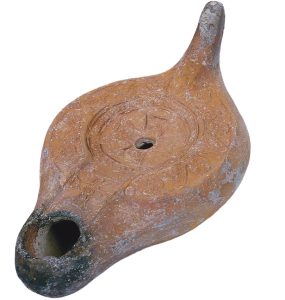
Clay lamp decorated with a cross in the center.
Α-15. A timeless means of lighting
Copy of an ancient lamp which burned olive oil inside and was used for lighting. Some of these lamps, discovered during excavations in the wider area of Greece, are in the Byzantine and Christian Museum of Athens, Greece and are dated to the mid-5th century AD. The importance of olive oil as a lighting medium can be seen in the ancient religious worship and later in Christianity. Strabo, in the 1st century BC, mentions that a “sleepless oil lamp” was burning in the temple of Athena Polias from where the settlers, who were setting off for new places, took with them “light” for the new homeland. In the Christian religion, since Byzantine times, olive oil was essential for lighting lamps in churches and monasteries. It is distinctively mentioned that the church of Hagia Sophia in Constantinople was lit by 3,000 oil lamps and for their supply the imperial family maintained separate olive groves especially for this purpose. Even today, the light of candles in churches and iconostasis in Greece is maintained by olive oil. In Crete, in particular, there was a specific word for the time when the oil lamps (“lychnoi”) were lit in every house: the word “lychnanamata”, which means to light on of lamps, was used when it was starting to get dark.
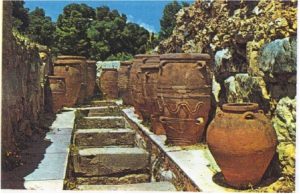
Α.16 The quantities
Copy of 275-year-old clay jars that the ancient Minoans had in the palace of Knossos in Crete in 3000 BC. Clay jars were at that time the modern way of storing and preserving olive oil during the heyday of the Minoan civilization in Crete, 3000-1450 BC. In the excavations of the palace from 1878 to 1930, jars of various sizes were found which were used by the Minoans to store olive oil, wine and grain. A recent study has shown that the estimated olive oil needed in a rich house in ancient Athens during the 5th century BC was 200-300kg per year, a very large amount, if one takes into account the extremely low efficiency of olive trees at that time.
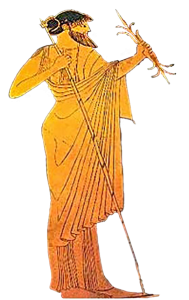
Sacred Supplication Bough
Α-17. The Suppliant and Supplication bough
Copy with a representation of a Suppliant (“iketis”) figure from a black-figured vessel of 530 BC. in Athens. Suppliant, in ancient Athens, was the one who went to Supplication because he was in danger and begged for safety. The Suppliant had usually committed a crime or serious offense and had violated a political or moral law. The Suppliant sought the protection from the protectors Zeus and Themis and often enjoyed the shelter of the sacred space. On the altar he placed the Supplication Βough (“iketeria”), i.e. a sacred olive branch wrapped in white sheep’s wool which remained on the altar as long as the request for supplication lasted. This particular combination of materials symbolized the sincere repentance of the suppliant and the purity of the specific ritual.
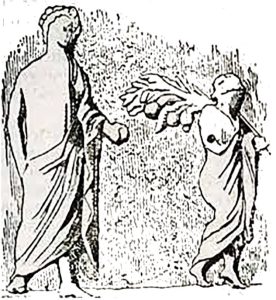
Α-18. “Eresioni”, the precursor of the Christmas tree
In ancient times, at harvest festivals, a green olive branch was offered to the Gods, on which they hung sheep’s wool and tiny clay pots containing olive oil, wine and sometimes honey. This creation was called “Eresioni” (from the word eros – erion meaning sheep’s wool). Eresioni was of a symbolic nature. It was an expression of people’s gratitude to the Gods for the fertility of the land and animals. Specifically, Eresioni was dedicated to the Goddess Athena, the God Apollo and the ancient goddesses Horai, “Eunomia” (Good Order), “Dike” (Justice) and “Eirene” (Peace). Specifically, on today’s dates between September 22 and October 20, children from non-single-parent families roamed Eresioni from house to house singing hymns of praise to the honored gods. At the same time, they urged the hosts of the houses who hesitated to make offerings to their own Eresioni (something equivalent to the current custom of Christmas Greek carols). During the Byzantine years the Eresioni custom was condemned as pagan and it was banned. But centuries later, the custom returned in the form of a Christmas tree from the Bavarians, as their own custom, when they accompanied King Otto to Greece in 1833 AD. Nevertheless, the custom of Eresioni always existed in the historical memory of the Greeks, and for this reason the Christmas tree was adopted almost immediately as a custom.
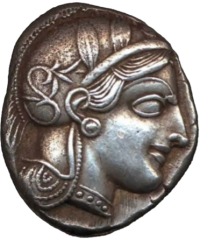
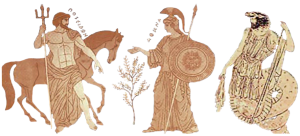
Α-19. The victory of Athena
Copy of the representation of the dispute between the Goddess Athena and the God Poseidon in the presence of King Cecrops, who reigned in 3000 BC., about who will give his name to the most brilliant Greek city-state. This representation is found on a black-figure krater (vessel) of the 5th century BC. According to the myth, the goddess Athena gave the citizens of Athens an olive tree as a source of wealth and nourishment for the population. On the contrary, the god Poseidon, as god of the sea, struck his trident on a rock and sea water flowed out which was unfit for consumption by the inhabitants of the city. In this way, the goddess Athena managed to be elected the protector of the city and that is why the city got her name. Indicative of the importance of the olive to Ancient Athens was that the Athenians on their coins depicted the goddess Athena with an olive wreath on her helmet and an amphora of olive oil or an olive branch.
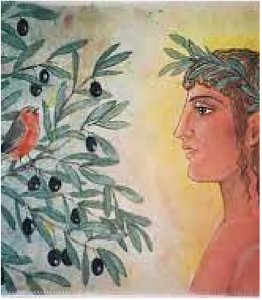
Kotinos (wreath) made of olive branches
Α.20. The prizes of games
In the ancient Olympic Games in Athens, the winners were crowned with a “kotino”, i.e. an olive wreath. A boy, whose parents had to be both alive, using golden scissors, cut green branches from the olive tree near the temple of the god Zeus and then took them to the temple of the goddess Hera and placed on a chryselephantine table. It was from there that the Hellanodikai, that is the officials who served as judges of the Olympic Games, took them and reverently made the wreaths which they offered to the winners as a prize. This was a distinction of the highest honor for any distinguished citizen. According to the myth, these wreaths came from an olive tree, planted by Hercules himself with a stalk that grew on his legendary club.
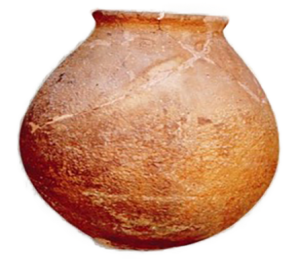
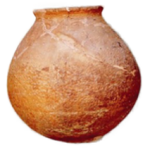
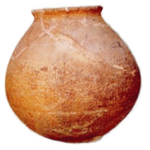
Α-21. The “trikouroupo” olive oil
Copys of the ancient clay crock pot (kouroupi) found in abundance, in almost all archaeological sites. The “trikouroupo” (three-pot) olive oil was a process of borrowing olive oil from the owner-producer to his villager who had run out of it. When someone ran out of olive oil, he would borrow two clay crock pots of olive oil, with the obligation that when he harvested the new crop, he would return three pots (that’s why it is called three-pot). A clay crock pot of olive oil was 6,41 kg, so 12,82 kg in total. This transaction was absolutely fair. The borrower received clear olive oil from the pot with no dregs in it, while he himself returned cloudy fresh-milled olive oil with no dregs removed, so the exchange was practically equal.

Domes of Hagia Sophia in Constantinople
Α-22. The oil lamps of Hagia Sophia
In the Byzantine years, olive oil was essential for the lighting of churches and monasteries. To illuminate the Temple of Constantinople, the theoretic church of Hagia Sophia, 3000 oil lamps were needed which consumed enormous amounts of olive oil. Emperor Basil the Macedonian dedicated the entire “Mantea” estate of the imperial olive grove to maintain the lamps of Hagia Sophia using its olive oil. While in the years of the Emperor Theodosius the Younger, Empress Theodora dedicated 10,000 “hectares of olive trees” to the temple of Jerusalem to light its oil lamps. In accordance with today’s cultivable area data, this particular olive grove covered almost 23,435 acres of land.
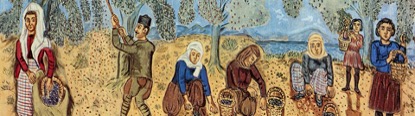
Folk painting showing olive harvest
Α-23. The “radoloi”
In the olive-growing regions there was an ancient unwritten rule of customary law intended to secure olive oil to families who did not own trees or did not have enough to cover their family needs. After the end of the harvest, everyone had the right to enter the olive grove and collect any olives that might have remained on the trees or on the ground. This custom, which in Crete was called “radoloi” (collection) or “koukoloi” is an expression of magnanimity and social solidarity. In fact, its solemnity was manifested by the blessing of the church. The producer who finished the harvest, reported it to the priest of his parish and he announced it the following Sunday in the church: “This man harvested his olives and whoever wants to, can go and collect”.
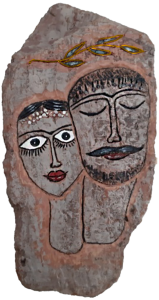
Α-24. Olive oil in everyday life
In Cyprus, during a traditional wedding custom called “allamata”, the family of the future bride and groom burn olive leaves in a small clay jar and pass it above their head (making circular movements) so to “protect them from evil” (the burning of olive leaves is an integral part of the orthodox religion). Also, in some areas of Greece and Cyprus, the holy crowns of the wedding couple were and still are made of olive branches. In Christianity, during the Sacrament of Baptism, the priest uses olive oil to shape a cross on the head and body of the baptized child. In several rural areas of the Mediterranean, people throw olive oil on the ground to have a good harvest or to thank God for the good harvest they had.
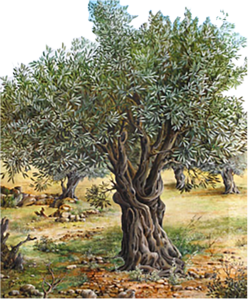
Α-25. What they wrote for Olive Tree / Characterizations of olive trees given by Greek historical figures
Dionysios Solomos (1798 – 1857): “Your soil is light like an olive leaf.” (funeral ode)
Giorgos Sepheris (1900 – 1971): “At night, on the blanket of Saint Nicholas, I dreamed of an ancient olive tree weeping.”
Odysseas Elytis (1911 – 1996): “Hey you, land and sea, the vines and the golden olives, listen to my news in my midday. No matter where I go, I only love this land.”
“I lived the beloved name in the shadow of Grandma Olive tree, on the shore of the eternal Sea.”
Sophocles (496 – 406 BC): Untouched self-growing tree, leafy olive tree.
Homer (9th – 8th century BC): “Stenofyli” (Narrow-leaved) olive tree, “Aglaokarpi” (Radiant – glorious fruit), “Telethoosa” (Florescent – full of life), “Stachtochlori” (silver-green color) olive tree, “Paidotrofa” (Refers to the fact that olive has nourished generations of children, paidi (child) + threfo (nourish))
Nikos Kazantzakis (1883 – 1957): Asimokloni (Refers to the color of the olive branch, asimi (silver) + kloni (branch))
Kostas Palamas (1859 – 1943): White-green tree, humbled, blessed, honored, fruitful.
Andreas Kalvos (1792 – 1869): Decent olive tree, Golden-fruit tree.
Odysseas Elytis (1911 – 1996): “Yiayia Elia” (grandmother olive tree)
Yiannis Ritsos (1909 – 1990): “Orfanes Elies” (Orphan olives)
Angelos Sikelianos (1884 – 1951): Thin olives.
Giorgos Sepheris (1900 – 1971): “Olives with the wrinkles of our parents”.
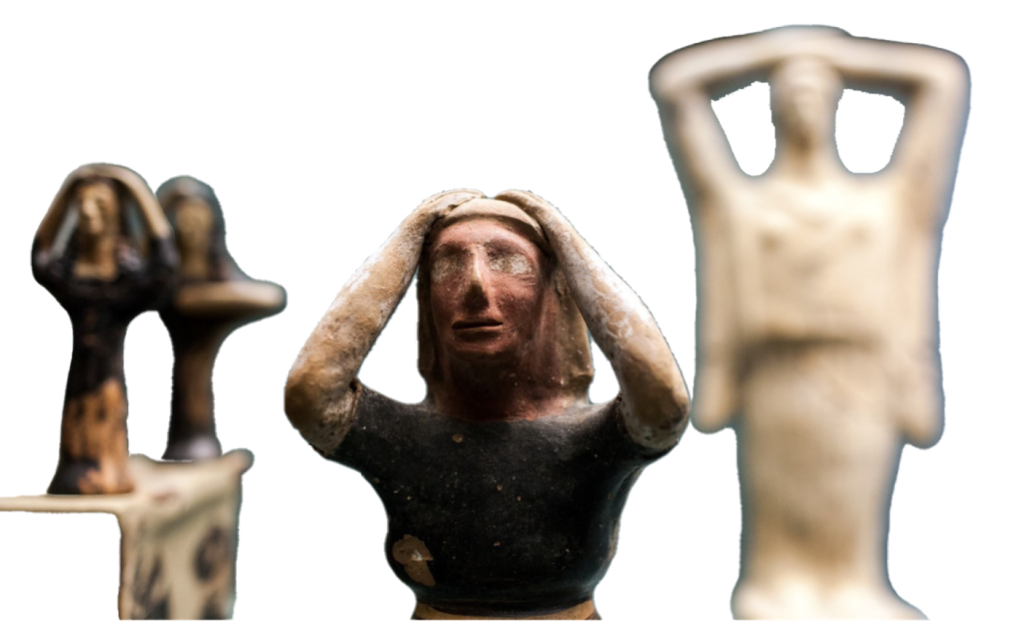
Α-26. Olive oil in mourning
Symbolic exhibit of the transition from life to death. In the recent past, they used to plant olive trees and cypress trees next to graves (in recent burial customs the planting of trees expresses people’s hopes for renaissance) while in ancient times they used to place olive leaves on the graves of the dead. Such findings have been discovered in graves of the 5th and 6th centuries BC. in ancient Feres, today’s town Velestino, in Greece. In Sparta, the lawgiver Lycurgus (800-730 BC) imposed the burial of the dead on branches of the sacred olive tree. In this way they believed that the deceased was purified during his descent to Hades (testimony of Plutarch, the Greek historian, biographer, philosopher and essayist 45-120 AD). Α proof that these ancient burial customs have survived is the fact that in some areas of Crete, for example the village of Petrokefali in the Prefecture of Heraklion, shortly before closing the grave, three olive branches are thrown inside. In the Orthodox worship, when the deceased is placed in the grave, the priest sprinkles the dead with olive oil from the candlestick of the icon of Jesus Christ or the Virgin Mary.

Kernos, Archeological site of Malia, Heraklion – Crete
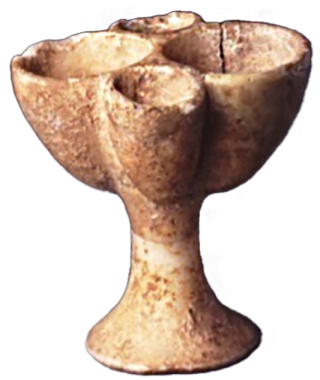
Kernos, Museum of Cycladic Art, Athens
Β-1. KERNOS: The gratitude to the Gods
Copy of Kernos (pottery ring or stone tray) of the Palace of Malia, in Heraklion, Crete (1900 BC) and Kernos in the island of Syros (2300-2000 BC). The Kernos of the Palace of Malia was discovered in 1915-1921 during the archaeological excavations in the area. The multiple upright Kernos belongs to the Early Cycladic period and was discovered in Syros in 1991-1996. Kernoi (in plural) were dented stone or ceramic containers or smaller vessels. Both were used as containers to put nuts, fruits or other products to offer to the shrine of the gods. This ritual and process was the way for people to express their gratitude for the rich fruitfulness of the land in the past year.
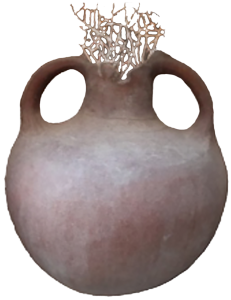
Β-2. The protection of olive oil
In the past, the ancient Greeks placed dried thorns in the spout of the clay storage containers of the olive oil to protect it from rodents. This was because their houses were not completely sealed and several small rodents could enter and cause damage on stored food. Also, in several cases, amphorae were kept in external storerooms to better preserve food due to cold. Thus, this protective measure was necessary to protect food and especially olive oil.
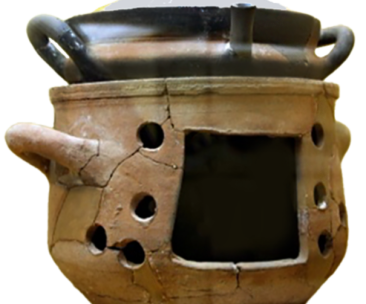
“Pyravnos”, the pressure cooker of the time
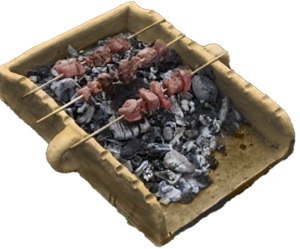
“Kandavlos”, the portable clay ember
Β-3. The ingenuity of people in the…kitchen.
Copies of Pyravnos and Kandavlos.
Β-3.1 Pyravnos: a pressure cooker with double clay walls and large dimensions. It had an average height of 40cm and a capacity of 18L. It consisted of an inner vessel, which was in contact with a larger one. The larger vessel had two rows of holes in its walls, so that when it was placed on the fire, air would circulate and the fire would be rekindled. So the food could be cooked even in a sheltered place and the embers with the coals would remain undiminished. The oldest found on the Acropolis of Athens is 2700 years old and is the first extant pressure cooker.
Β-3.2 Kandavlos: Small portable clay ember. Made with special slots to place the food that was passed on sticks – thin branches to cook more easily and quickly. It is believed to be the first extant portable grill. It is dated to the Late Cycladic period (1.550 – 1.100 BC) and was found in the Akrotiri area on the Santorini island, in Greece.
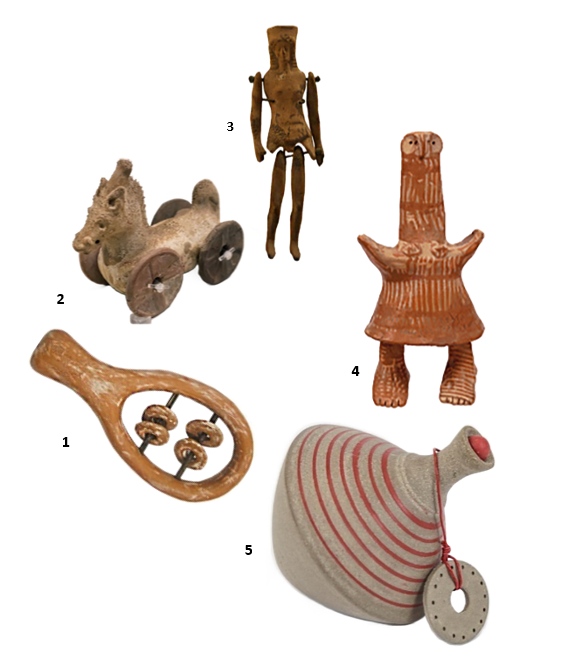
Copy of toys in Minoan (3000-1450 BC) – Archaic period (800-500 BC)
Β-4. Inventiveness in play.
Β-4.1
1. Clay bell stick from the Archanes area in Heraklion, Crete, which dates from 2000 BC and is considered the oldest musical instrument in Europe.
2. Clay horse with wheels 1500 BC.
Β-4.2
3. Minoan clay figurine with movable parts (3000-1450 BC)
4. Archaic Greek terracotta (firing clay sculpture with a brownish-orange color) of the 7h century BC.
5. Clay spinning top of the 8th century BC.
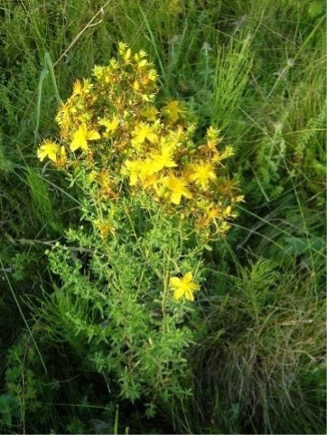
C-1. ST JOHN’S WORT (HYPERICUM PERFORATUM)
St. John’s wort is proven to be an excellent wound and stomach ulcer healer. The ancient Greeks and Romans believed that this herb protected against witchcraft and evil energy. During the Middle Ages, Christians had the pagan perception that it repels evil spirits, and on the eve of the feast of St. John, they burned it to purify their home. Finally, they took some of the ashes of the St. John’s wort and spread it on their land so that they could have good harvests in the following year.
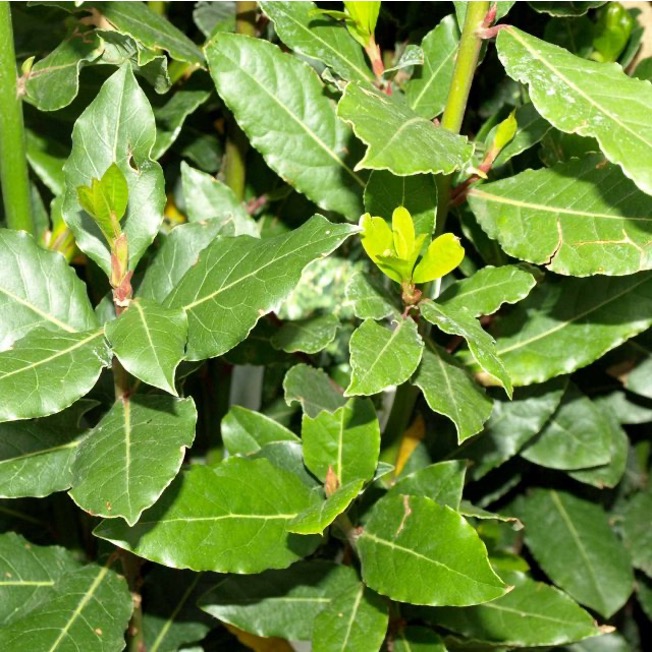
C-2. LAUREL (LAURUS NOBILLIS)
The leaves and fruits of the laurel are used for the preparation of laurel oil because they are rich in antiseptic, anti-inflammatory and soothing properties. One of the main uses of laurel oil is the treatment of skin problems. Due to the oleic acid it contains the bay laurel oil makes the skin shiny and soft. Also, due to its antiseptic and antibiotic properties, bay laurel oil can be used to inhibit the growth of bacteria, germs and fungi on the skin and scalp. After all, these are the reasons why laurel oil was often used as a cosmetic since ancient times.
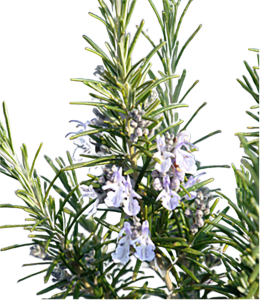
C-3. ROSEMARY (ROSMARINUM OFFICINALIS)
Rosemary has been shown to work as a very good tonic that acts against physical and mental exhaustion. At the same time, it is an excellent aromatic plant which is widely used for culinary purposes. For the same reason it is added to some alcoholic beverages. It used to be believed that it only grew in the yard of righteous people, because it strengthens people’s memory and thus became a symbol of loyalty, friendship and remembrance. In order to achieve better performance Ancient Greek students believed that they should ware rosemary wreaths during their study as it locally increases blood circulation.
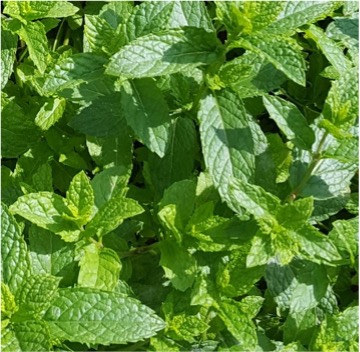
C-4. MINT (ΜΕΝΤHA PIPERITA)
Mint is an aphrodisiac and sedative herb. It is used in cases of indigestion and diarrhea. For centuries Arabs have been drinking peppermint tea as a sexual stimulant. The ancient Greeks rubbed their tables with mint before eating and soaked their bath water with its leaves. Since the 6th century in England and France, nobles and prominent citizens cleaned their teeth with mint-scented creams to reduce bad breath and maintain the best possible oral hygiene.
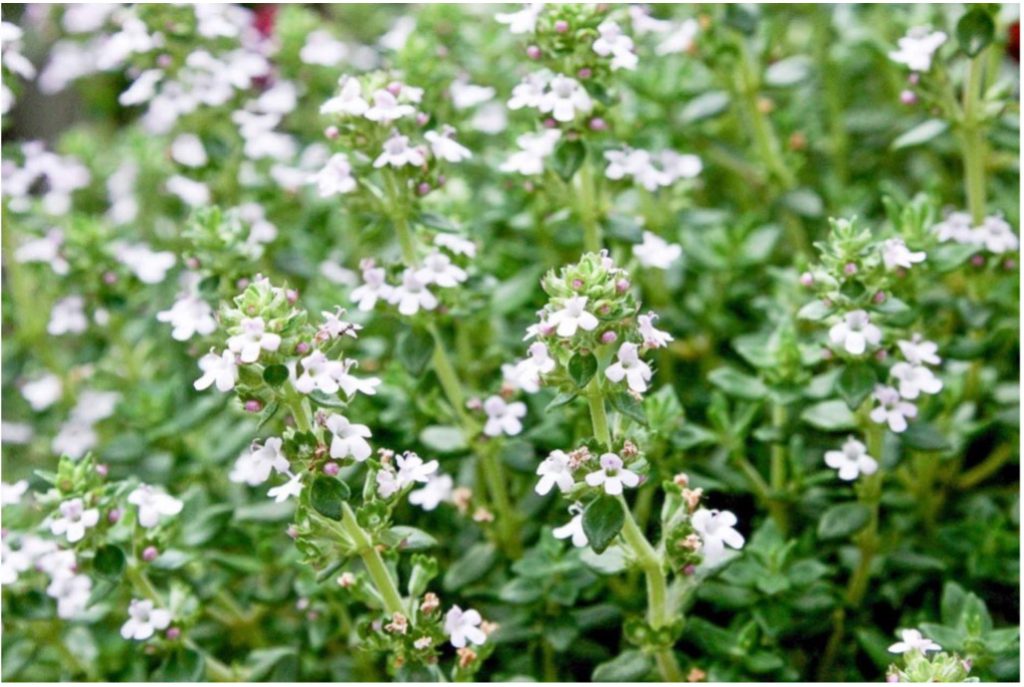
C-5. SAVORY (ΤHYMBRA, SATURELA MONTANA)
Savory is recommended in cases of stomach disorders. It is also used as a flavor enhancer in cooking and as a food preservative. The ancient Greeks used to use savory to make Thybritis Wine. Nowadays, in many countries they add it to liqueurs to make digestive liqueurs. Finally, savory is being used to flavor dried figs, raisins and olives so to bring out more of their natural aroma and to make them smell “better” by covering possible bad odors.
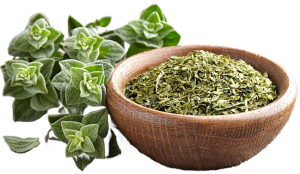
C-6. OREGANO (ORIGANUM VULGARE)
Oregano is perhaps the most well-known ingredient used for appetizers which is combined with a multitude of flavors, from vegetables (a world-famous accompaniment to Greek salad) and pasta to meat and fish. Less well known but equally effective is its tonic action for muscular and rheumatic pains. The ancient Greeks used its decoction for spasms, colic and poisoning. Also, using a paste they made by melting fresh oregano leaves, they rubbed the places where there were intense muscle pains on their bodies.
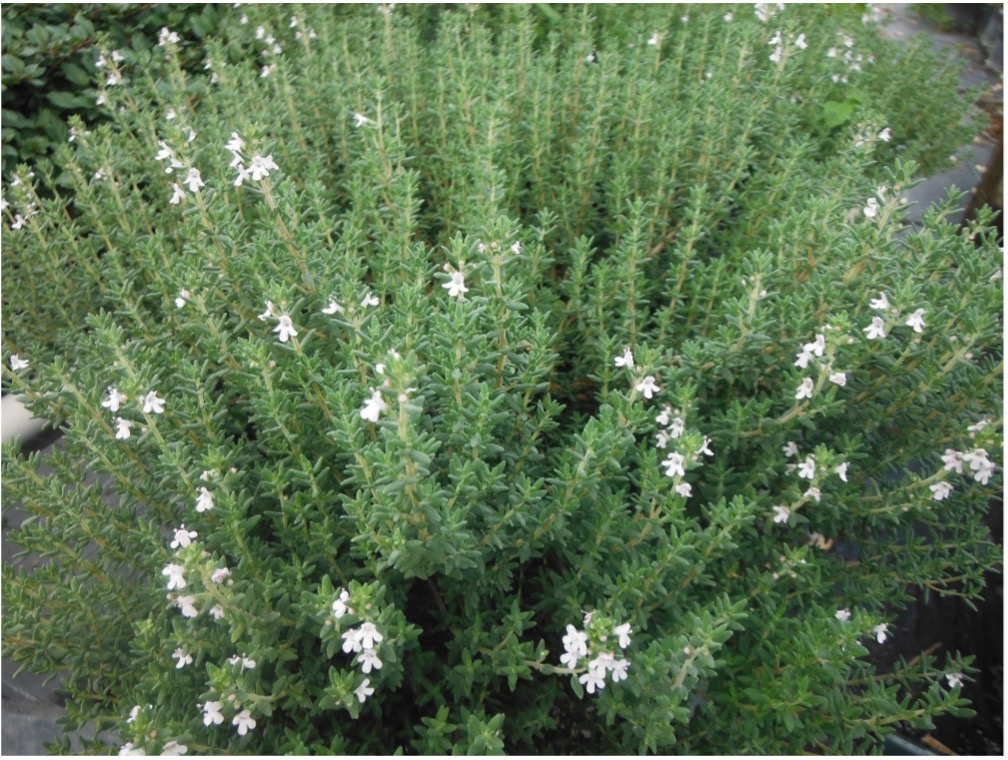
C-7. THYME (THYMUS VULGARIS)
Thyme is considered suitable for physical and mental stimulation. Also fights intestinal parasites and has a microbicidal effect on the body. In therapeutic medicine it is known as the herb with the most medicinal properties. Roman soldiers during wars, bathed in water aromatized with thyme to gain vigor and strength. Thyme essential oil is 25 times more antiseptic than other antiseptics such as phenol and hydrogen peroxide.

C-8. SAGE (SALVIA OFFICINALIS)
“He who would live for aye must eat sage in May” (old English proverb). The Romans called sage a sacred plant. In the 7th century AD the doctors of the Medical School of Salerno in Italy believed that whoever had sage in his house was not afraid of death. During the great epidemic of the Plague, in 1630 AD. some cunning robbers anointed their bodies with a decoction of sage, thyme, lavender and rosemary and stole money from the corpses. When they got arrested, the judges spared their lives in exchange for the secret that made them immune to the plague. It is considered one of the best decoctions with multiple benefits for the body.
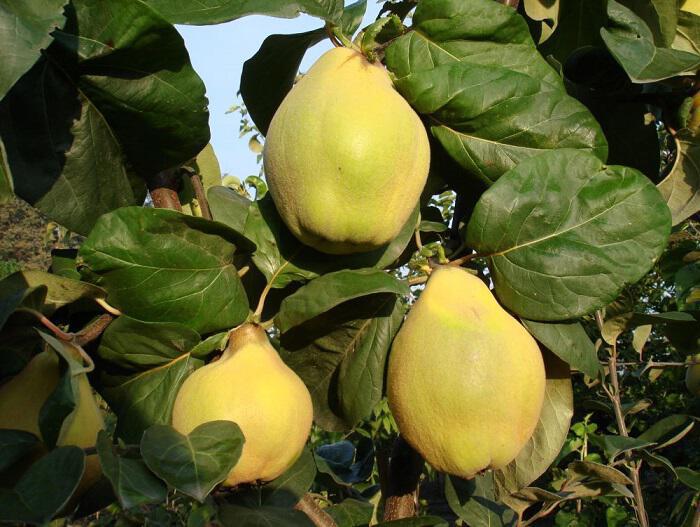
C-9. QUINCE (PYRUS CYDONIA)
Quince seeds, after being boiled in water and extracted, they yield a highly soothing decoction for the throat, essential for singers and chanters. Also, in ancient times, women used quince as an aphrodisiac with an immediate effect to attract the man of their choice. The ancient Greeks considered the quince fruit an emblem of love success and had dedicated it to the Goddess of Love Aphrodite.

C-10. POMEGRANATE (PUNICA GRANATUM)
The small inner fruits of pomegranates are an excellent source of antioxidants for juice and cosmetics. Pomegranate fruits have been considered as symbol of fertility since ancient times and during the early Christian years it was already a well-known custom to hang pomegranates on the entrance doors of houses as a sign of good luck. Hippocrates describes pomegranate juice as digestible and aphrodisiac. Finally, it is scientifically proven that the emulsion of pomegranate juice and extra virgin olive oil has anti-wrinkle properties.

C.11. CYPRESS TREE (CUPRESSUS SEMPERVIRENS)
Cypress is a mild, natural insect repellent and its fruits (cypress balls) are widely used in soaps and ointments against hair loss. According to mythology Cyparissus was a young man from Gia who as he died in grief – because he had killed the God Apollo’s beloved deer – begged him to keep the memory of his sorrow immortal. God Apollo heard him and accepted his sincere repentance and transformed him into a Cypress.

C.12. LAVENDER (LAVANDULA OFFICINALIS)
Lavender is an exquisite aromatic sedative and antiseptic.
The Romans used it in their bath and also to aromatize their clothes, as it is done today, while it protects against moths.
The Alpine hunters, when their dog is bitten by a snake, they use lavender to treat the wound.
Our ancestors chewed fresh lavender leaves and then rinsed their mouth with running river water. Based on their descriptions, this gave them clean breath and a feeling of freshness in the mouth for quite some time.
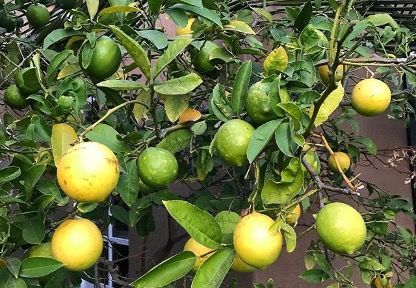
C.13. LEMONS (CITRUS MEDICA SATIVA)
Lemon juice has antiseptic, antibacterial and anti-scurvy properties. Ancient Greeks used to call lemons “Persian apples” due to their Persian descent. It is said that Casanova used to advise his mistress to use lemon juice as a contraceptive. British ships are obliged to carry specific quantities of lemons for the prevention of vitamin deficiency of sailors. Each sailor who travels for more than 10 days must consume 30gr of lemon juice daily for his health safety and to avoid hypovitaminosis.
Thank you for your visit.
You can find some of the above rich/valuable herbs at our shop and take advantage of their beneficial properties.